

Problem
The Problem We Solve
The Problem We Solve
Clinicians spend 5-6 hours every day on clinical documentation, time stolen from patient care. This administrative burden fuels provider burnout, reduces patient face-time, delays billing, and drives away the best talent. The system is breaking, and documentation is the bottleneck.
Solution
The Solution: Suki Web SDK
The Solution: Suki Web SDK
Imagine clinicians walking into an exam room, having a natural conversation, and walking out with complete clinical notes already generated, without ever touching a keyboard. That’s what the Suki Web SDK delivers today.The Suki Web SDK transforms a partner’s healthcare application into an intelligent partner that listens, understands, and documents while clinicians focus on patients. Using ambient AI, it captures conversations naturally and automatically generates structured clinical notes in the background.What This Means for Partners: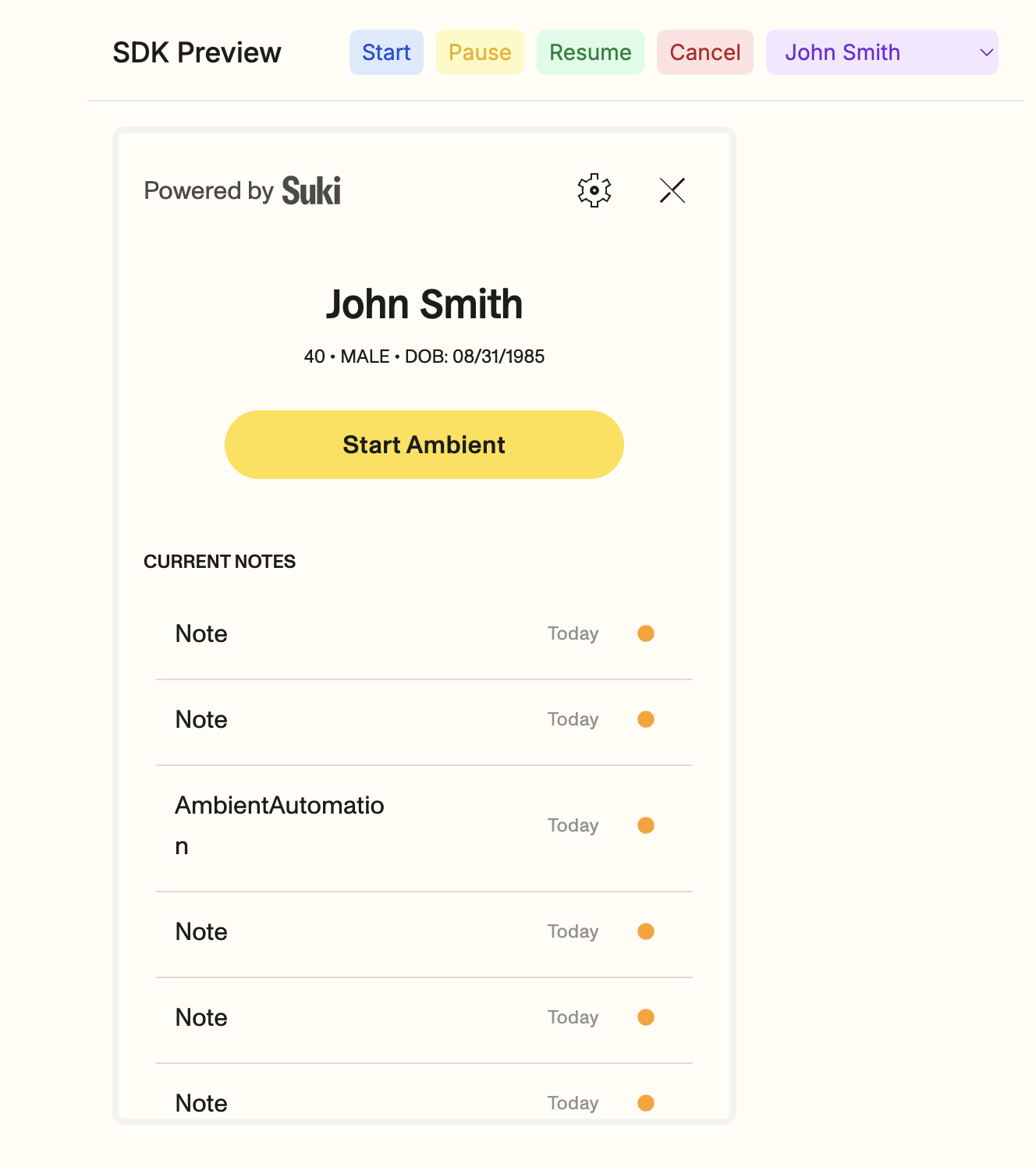
- Rapid Integration: Pre-built UI components transform a 6-12 month project into a 2-4 week sprint. Partner teams don’t build AI infrastructure—they embed it.
- Production-Ready: Battle-tested components powering thousands of clinical encounters across leading platforms, proven at scale.
- Framework Flexibility: Works with React, JavaScript, or any modern framework. No rewrites. No compromises.
Key Use Cases
EHR Integration
Embed ambient documentation directly into the EHR. Clinicians never leave their workflow. Notes flow seamlessly into patient records, formatted perfectly for the system’s structure.
Telehealth Platforms
Elevate virtual care beyond video calls. Suki captures every conversation detail during telehealth visits and generates complete documentation automatically. No post-visit documentation marathons.
Specialty Care Systems
Every specialty speaks its own language. The SDK adapts to each specialty’s unique requirements, ensuring notes are clinically precise and specialty-appropriate, not generic templates.
Care Management Platforms
Empower care coordinators to focus on coordination, not documentation. Every patient interaction gets captured automatically, freeing teams to ensure patients receive the right care at the right time.
How Integration Works
To integrate the Suki Web SDK, partners follow a five-step process: from initial setup to delivering completed notes to the EHR.Business Benefits
Faster Time-to-Market
Faster Time-to-Market
Weeks, not months. While competitors spend 6-12 months building AI infrastructure, partner teams integrate production-ready components in 2-4 weeks. That’s 80% less development effort and months of competitive advantage. No AI training. No infrastructure scaling. Just proven components that work from day one.
Cost Savings
Cost Savings
When clinicians reclaim 2-3 hours per day from documentation, they see more patients, driving increased revenue. Reduced burnout lowers turnover costs and improves retention. Immediate note completion means faster billing cycles. The ROI compounds across every dimension of the organization.
Competitive Differentiation
Competitive Differentiation
In a crowded market, AI-powered documentation isn’t just a feature. It’s a statement. Position the platform as the innovation leader. Attract forward-thinking clinicians. Watch adoption climb as word spreads about a platform that actually makes lives easier. This is future-proofing competitive position.
Improved Quality of Care
Improved Quality of Care
When clinicians spend less time documenting and more time with patients, magic happens. Eye contact increases. Empathy deepens. Clinical decision-making improves. Complete, timely notes mean better care continuity. Providers stay because they feel supported, improving both patient outcomes and organizational stability.
Security & Compliance
Security & Compliance
HIPAA compliant. SOC 2 Type II certified. End-to-end encryption. Every conversation protected. Every note secure. Suki handles compliance infrastructure, so partners don’t bear the burden. Enterprise-grade security without the complexity.
What Partners Need
Partners likely already have everything needed. The SDK integrates with existing infrastructure. No major overhauls required.✓ Identity & Security System
An existing authentication system (OAuth 2.0 or similar) is the foundation. The SDK connects to what’s already in place. Most organizations already meet these requirements.
✓ Development Environment
Teams building web applications with React, JavaScript, or any modern framework are ready. Standard tools and package managers are all that’s needed.
✓ Clinical Knowledge
Clinical teams already understand their specialties and documentation requirements. That expertise configures the SDK for optimal note generation.
✓ EHR Integration Capability
Most EHRs already support receiving structured data. The SDK delivers notes in standard formats. Organizations that can receive data and push it to the EHR are ready.
✓ Audio Capabilities
Standard web browser microphone permissions and HTTPS connections. Capabilities every modern web application already supports.
✓ Provider Information
Provider names and organization IDs are standard data points already available in most healthcare systems.
Critical Technical Requirements
These five areas require attention for smooth deployment. Each requirement is standard for modern healthcare applications.- Authentication
- Installation
- Specialties Information
Requirements:
- OAuth 2.0 compliant identity provider or custom JWT generation system
- Publicly accessible JWKS endpoint (HTTPS) for token verification
- JWT tokens signed with RS256 algorithm
- Required claims:
exp,iss,aud, and user identifier
- Note Output & EHR Integration
- Microphone Permissions
Requirements:
- Infrastructure to receive note submission events or callbacks
- Logic to parse LOINC-encoded JSON structure
- Workflow to map Suki’s output format to the EHR’s expected format
Success Stories
Real organizations transforming care delivery today.athenahealth Partnership
Over 60,000 clinical encounters completed, and counting. athenahealth integrated Suki’s ambient technology into their EHR platform. Clinicians report dramatic time savings and quality improvements. What started as a pilot has become a core capability, proving ambient documentation is transformative at scale.Read Case Study →
WellSky Integration
WellSky’s Ambient Listening solution is changing the game across behavioral health, long-term acute care, and rehabilitation settings. By streamlining documentation and reducing burnout, they’re helping providers rediscover why they entered healthcare. The impact extends beyond metrics to provider satisfaction and patient care quality.Read Case Study →
Zoom Healthcare Partnership
Zoom recognized that telehealth needs intelligent documentation, not just video calls. By integrating Suki’s AI engine, Zoom delivers a complete virtual care experience that improves both user experience and patient outcomes. This demonstrates how ambient intelligence becomes a competitive differentiator.Read Case Study →
What Partners Get
When integrating the Suki Web SDK, partners get a complete solution ready for production from day one.Pre-Built UI Components
Beautiful, intuitive components that work immediately. Fully customizable to match partner brand. No months of UI development required.
Production-Ready Code
Battle-tested components that have processed thousands of real clinical encounters across leading platforms. Performance-optimized and production-ready.
Framework Flexibility
Works with React, JavaScript, Vue, Angular, or any modern framework. No rewrites. No compromises. Just seamless integration.
Specialty Optimization
Optimized for 100+ medical specialties. Cardiology notes look different from behavioral health notes, because they should. Clinical precision meets technical excellence.
Multilingual Support
Supports 80+ languages for conversation capture with automatic English note generation. Patients speak in their native language. Providers receive perfectly formatted English documentation.
Customizable Branding
Everything customizable to match the design system. Colors, fonts, UI elements. End users recognize it as part of the platform, not a third-party add-on.
Integration Timeline
From concept to production in weeks, not months.- Week 1: Partner onboarding and environment setup
- Week 2-3: SDK integration and UI customization
- Week 4: Testing, QA, and production deployment
Next Steps
Transformation starts with a single conversation. Here’s how we work together:Schedule a Demo
See it in action. Watch the Suki Web SDK transform a live clinical workflow. Our team demonstrates use cases specific to the partner organization and shows exactly how it fits into their systems.Contact Partnership Team →
Technical Assessment
We’ll map the path. Our Solutions Engineering team dives deep into the partner’s technical environment and creates a customized integration plan. Partners will know exactly what’s required and how long it will take.
Pilot Program
Prove it works. Start small with 5-10 clinicians to validate the integration in a real-world environment. Gather feedback. Build confidence. By full deployment, partners will have proof points and champions.
For Technical Teams: Ready to dive into the details? Comprehensive technical documentation, API references, code examples, and step-by-step implementation guides are available in the Web SDK Documentation section. Everything development teams need to build is waiting there.